Every fit out company in London claims to be sustainable. Most of them mean they use LED lighting and have a recycling policy. That is not sustainability. Real sustainable office design requires harder choices, honest conversations, and a willingness to prioritise long-term impact over short-term cost savings. Here is what that actually looks like.
Where the real environmental impact lives
The biggest environmental cost of a commercial fit out is not the energy the building uses day to day. It is embodied carbon - the emissions generated by manufacturing, transporting, and installing materials. A typical office fit out produces around 70 kg of CO2 per sq metre. Strip it out and start again five years later and you have doubled that figure. The most powerful sustainability decision you can make is designing a workspace that lasts.
That means specifying durable materials that age well rather than cheap alternatives that need replacing. It means choosing modular furniture systems that can be reconfigured and reused rather than bespoke joinery that only fits one layout. And it means having honest conversations with clients about the trade-off between a lower upfront budget and a higher lifetime environmental cost.
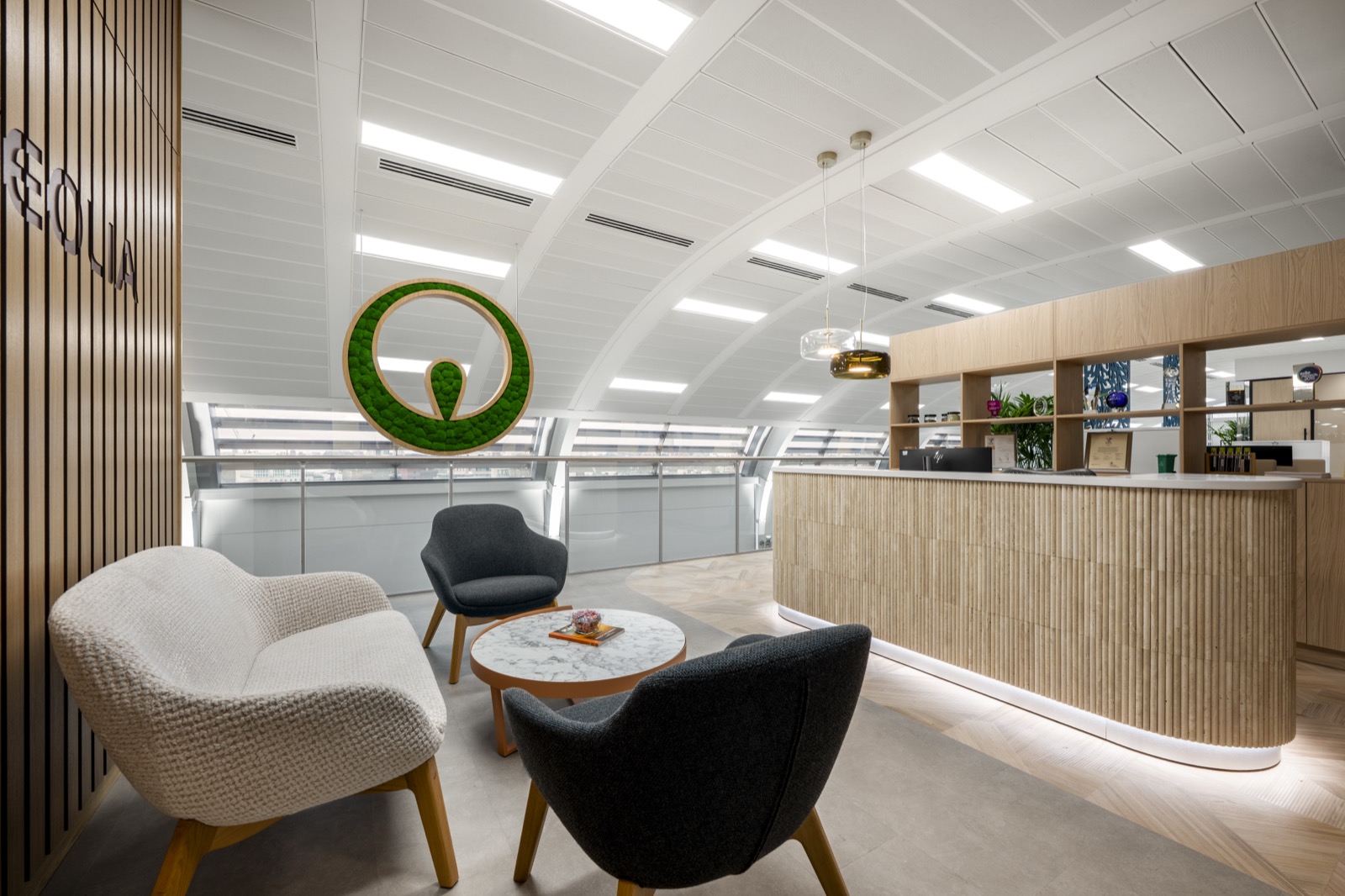
Reclaimed and locally sourced materials reduce environmental impact without compromising on design quality.
Circular economy principles in practice
The circular economy is not a theory for sustainable office design. It is a practical framework. On every project, we ask three questions. Can we reuse what is already there? Can we specify materials that will be reusable at end of life? Can we divert waste from landfill during the build? On a recent project, we diverted 94% of construction waste from landfill and reused 60% of the existing furniture - saving the client money while dramatically reducing embodied carbon.
Supply chain matters enormously. We work with manufacturers who offer take-back schemes, use recycled content, and publish transparent environmental product declarations. FSC-certified timber, low-VOC finishes, recycled steel, and carpet tiles made from reclaimed fishing nets are all standard specifications on our projects now. Five years ago, these were niche options. Today, they are readily available and cost-competitive.
The most sustainable workspace is the one you do not have to rip out in three years. Designing for adaptability is the most powerful sustainability strategy there is.
Accountability, not greenwashing
As a B Corp-certified business, we hold ourselves to standards that go beyond marketing claims. We measure and report the environmental impact of every project. We set reduction targets and track progress against them. That accountability matters because sustainability without measurement is just good intentions. Learn more about our values and approach on our story page.
The industry is moving in the right direction, but not fast enough. Clients are increasingly asking the right questions - about embodied carbon, material provenance, and end-of-life planning. The businesses that take sustainable office design seriously now will be ahead of regulation, ahead of their competitors, and ahead of the expectations of the next generation of employees. If you want to explore what a genuinely sustainable office refurbishment looks like, let us talk.